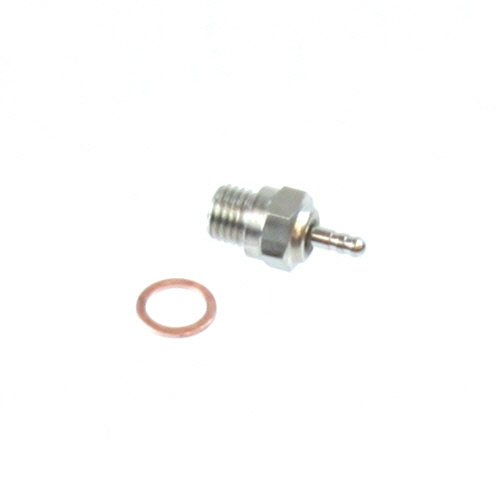
Installing the Sullivan Onboard Glow Driver can range from a very easy straightforward job all the way to an entailed installation that requires a bit of thought. A single engine installation in a sport plane would be very easy and straightforward. The control panel needs to be mounted on the side of the fuselage, which can be done so that it's mounted close to the receiver and the separate battery pack. Then the wires need to be run to the engine to complete the glow circuit. But for my twin-engine application there were some problems that immediately showed up as I prepared to install the driver. Those problems were:
- Sonic Tronics Inc / McDaniel:: * OnBoard Glow Systems 4.8V pulsed On-Board Glow Plug Driver Systems are available for engines with one to nine glow plugs or multi-engine setups. They deliver power for starting and maintaining idle during taxiing and power down flight maneuvers.
- Just push down, rotate, and it's locked onto the glow plug for hands free operation. The Metered NI-STARTER has a durable, shock resistant, dual faced amp meter to show the condition of your glow plug.
Find great deals on eBay for rc glow plug driver. Shop with confidence.
- The Hangar 9 B-25 is a large plane, and for reasons of balancing the plane the glow driver battery needed to be installed in the nose of the plane. With the battery in place I needed to decide where to place the control panel of the unit. After looking at several different locations on the fuselage I decided to place it in the nose of the plane, directly underneath the cockpit. The main reason why I choose this location was because the battery for the driver was in this location as well and I could keep the wire to the battery short in length when the panel was placed here.
- The glow driver seems to be designed for a one-piece wing. With the included wiring the instructions tell you to run a ground wire between the two engines. The H9 B-25 has a two-piece wing so this presented a real problem for wiring the driver to the engines. I needed to find a way to run the wires separately to each wing.
- One other problem that I noticed here was that the design of the driver unit did not seem to take into account that most twin-engine applications have the engines mounted on the wings. With a single engine application the entire unit can be installed in the fuselage and not be involved with the wing whatsoever. But in a twin-engine setup the engines are mounted on the wing, and if the control panel is mounted in the fuselage some provision must be made in the wiring so that the wing can be removed from the fuselage.


To solve the problem of the ground wire and the removable wing I chose to run two sets of wires (glow plug power and ground) from the control panel, one set going to each engine. This solved the issues of having two wing halves; by running a set of wires to each engine the halves could easily be separated. But this left me with the problem of removing the wings from the fuselage itself. To solve this I used a power plug and jack (available from Radio Shack) for each set of wires. I simply cut the wires where the wing would join to the fuselage and installed the plugs and jacks. Now when the plane is assembled at the field it?s a simple matter of plugging in the wires for each wing half.
Rc Glow Driver For Mac
Next up is mounting the control panel for the onboard driver in the fuselage. As I said earlier, I choose to mount it under the cockpit of the plane because this is where the driver battery is located, and the panel will be mounted next to the radio power switch. To mount the panel, first cut a 1-13/16' x 3/4' rectangular hole in the fuselage. The backside of the control panel is removed by taking out two Allen screws that hold it together. Then the front of the unit is installed from the outside of the fuselage, running all of the wires to the inside of the plane. Once I had the control panel in place the backside is then screwed back in place using the Allen screws through the front of the panel.
With the panel in place it was time to extend the wires. Since the battery was located directly behind the onboard driver there was no need to extend the wire for this. But this still left me with the glow plug positive connection, glow plug negative connection, and the wire to the receiver that needed to be extended. For the wire to the receiver I used a standard JR servo extension wire to connect the unit to the receiver. For the glow wires I extended them both to the power jacks that I installed in the fuselage. In the wings I connected the wires to the power plugs and routed the wiring to each engine nacelle. At the engine I connected each ground wire to an engine-mounting bolt to ensure that I had a good ground. For the glow plug connection I had to remove the twist lock connectors that were provided because they extended outside of the cowl of the B-25. I soldered two small steel spring clips to the wire and placed heat shrink over it to ensure that the clip didn?t touch the engine and short out the driver. I then attached the clips to the glow plugs.
Rc Onboard Glow Drivers
While it sounds pretty complicated it really was a pretty easy installation once I had everything figured out on how I was going to install the unit.
Once the unit is in place programming it is really very simple. There are a couple of ways that the unit can be used. The first is a simple on/off operation. When you are ready to energize the glow plugs turn on the unit with the 'On/Off' switch and then press the 'Run' button. The unit will turn on the glow plug, which will be indicated by a solid green LED. If the glow plug is burned out the LED indicator will flash when it?s turned on. Once you have the engine started simply slide the switch to the 'Off' position to turn off the unit.
The second method to use the unit would be controlled with radio. To do this the unit needs to be programmed. The unit needs to be connected to a channel on the radio that you will use to control the glow driver; most often used will be the throttle channel. For automatic operation, set your throttle stick to the position that you want the plug to come on. Push the white button under the SET hole, and the LED will begin flashing about twice a second for several seconds. Increase throttle on the transmitter while the LED is flashing. This orients the unit for high vs. low throttle direction. When the flashing stops, the set point and direction is stored in memory. You can redo this as often as desired. Check the set point by moving the throttle up and down through the set point. The LED will indicate that the plug is on or off. You can change the set point at any time by repeating the above step. If you do not want the unit to come on automatically, move the throttle stick to the lowest position (off) and set the ON position there. You can also turn the Driver off with the main switch; the throttle servo will still work.