- Air Force One N7 Drivers For Macbook Pro
- Air Force One N7 Drivers For Macbook
- Powerbilt Air Force One N7 Irons
Save powerbilt air force one n7 driver to get e-mail alerts and updates on your eBay Feed. + PowerBilt Air Force One N7 10.5* Driver Right Stiff Flex Fujikura UL 55 # 58890. Power Bilt Air Force One N7 20 Degree 3 Hybrid Graphite Stiff Flex 162052 Used See more like this. Air Force One DFX Tour Black Driver. Nitrogen Charged. First, let me explain the necessity for the nitrogen in the head of the golf club. When I initially read the bottom of the club and saw the promotion of the nitrogen, I thought it was a sales gimmick.
“The PowerBilt Air Force One N7 is the longest driver we’ve tested thus far in 2010!”
The PowerBilt Air Force One N7 Review!
As I discussed when I reviewed the Solus FC-10 wedge, I’m inherently suspicious of any golf club for which the only advertising I see comes in half hour blocks on the The Golf Channel. Advertise your Golf GPS, I’m all ears. You can probably even convince me that your training aid is worth buying too. But when you advertise an actual golf club, and your commercial spot comes right on the heals of those despicably awful spots for The Hammer, well…I’ll be honest, it’s a hard sell getting me to take your seriously, and from my conversations with other golfers, I’m not alone.
Now I don’t mean to suggest for one second that the PowerBilt Air Force One should be greeted with the same contempt as the Hammer. After all, The Hammer is nothing short of the worst driver I’ve ever hit in my life, whereas, PowerBilt has been a respected part of the golf industry for nearly a century. Their clubs have been in the bags for 8 major victories, as well as victories in over 100 PGA and LPGA events. Any kid who has ever picked up a bat, or a hockey stick is familiar with sister brands Louisville Slugger, TPX, TPS, or Lousville Hockey. Golfers who don’t know the PowerBilt brand, maybe familiar with Bionic gloves, which also falls under the same corporate umbrella.
The short of it, PowerBilt made its bones a long time ago, and though many newcomers to the game might not know the brand; like MacGregor, the company, despite an admittedly smaller footprint than it once had, it still in business and still making a quality product.
Now that we got that out of the way, let’s talk about the proverbial pink elephant in the room. His name is Nitrogen. That’s right, in case you missed it The PowerBilt Airforce One N7 is the 2nd generation of clubs from PowerBilt to be “Nitrogen Charged”. PowerBilt claims that by pairing an ultra-thin face with a head full of Nitrogen, they can maximize the trampoline effect, which leads to guaranteed distance increases of 10 to 20 yards over your current driver. Did I mention the heads are filled with Nitrogen?
Anytime somebody guarantees 10 yards I start thinking one of 2 things is going on. Either they’re stretching the truth a bit, or they’re engaging in some other type of deception (decreasing lofts, increasing shaft lengths, etc.). Tell me that 10 extra yards comes from Nitrogen, and I’m going to laugh out loud. Of course, when I’m done laughing, I’m going to want to see if there is anything to it (I may be a skeptic, but I’m skeptic willing to be proven wrong). Fortunately for us, PowerBilt sent us two of the N7 drivers (Tour, and High MOI/standard) to test for ourselves.
Airforce One N7 Technical Specifications
- Available Loft:8.5° (Tour Only), 9.5°, 10.5°, 12.5° (MOI only)
- Length: 45.5″
- Volume:460cc
- Swing Weight: D3
- Stock Shafts: Fujikura (proprietary), Fujikura (E-350 Tour)
What We Tested, and How We Tested It
Like we often do when we receive a new club, we tested the specifications against the manufacturers stated specs. I then taped the crown and sole with Ghost Tape to protect the clubs during our testing process and finally, we have golfers hit the product, and provide their opinions, and of course, provide us with actual performance data.
All performance testing was done using PGA TOUR Simulators, powered by 3Trac, from aboutGolf. Testing took place at Tark’s Indoor Golf Club; a state-of-the-art golf training, club fitting and repair facility located in Saratoga Springs, NY.
With our simulator’s data capture capabilities disabled so that distance and accuracy wouldn’t influence our subjective opinion polling, we asked several golfers to provide us feedback on the look, sound, and feel of the clubs. We also asked for their opinion on the overall value of the club, as well as the quality and performance of PowerBilt products to the industry as a whole.
A subset of testers including golfers with low, middle, and high handicaps, was asked to participate in more thorough tests where data was collected for the shots they hit with the PowerBilt Airforce One N7 Tour and MOI drivers.
For full details of MyGolfSpy’s testing methodology, see our testing details page.
Performance Rating
You’ll probably recognize most of our testers names on the chart below. While some did approach that 10 extra yards that PowerBilt promised us. On average, no one was 10 yards longer than their previous longest driver tested thus far. We also have to point out that though not necessarily 10 yards longer, on average, the PowerBilt Air Force One N7 is the longest driver we’ve tested thus far in 2010! I’m shocked. One other detail worth calling attention to, with the exception of Ben, all of our testers hit the Tour model longer than the standard/High MOI/Air Foil model.
Distance Grade: A+
Like just about every other OEM in the industry, PowerBilt claims the N7 is an incredibly accurate driver. Perhaps it’s measurably more accurate than anything the company has created to date, but our numbers tell us that from an accuracy perspective, the new Air Force One drivers fall somewhere in the middle of other 2010 drivers we’ve tested thus far.
Accuracy Grade: B
The Numbers For The 6 Golfers:
>> Performance Score:(53 out of 60)
Subjective Rating
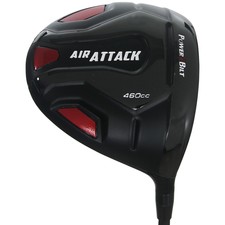
Looks
One of the observations I’ve made over the years is that the OEMs with the huge budgets tend to make nicer looking clubs. They don’t always get it right, but even their worst mistakes often appear more polished than the best work of smaller companies. While the Powebilt Air Force One N7 isn’t hideous, our testers weren’t overly taken with it either. It’s a step up for sure over the previous model, but our survey results show PowerBilt still has plenty of room to improve.
Looks Grade: C+
Sound
Somewhat surprisingly, this new version of the PowerBilt Nitrogen driver has done a solid job creating a pleasant sounding driver, especially compared to the previous model from a year ago. While it didn’t rate as highly as a select few other that we’ve tested, the presence of Nitrogen doesn’t seem to have any negative impact on the acoustics, and most of our testers told us that they more or less were happy with the sound it produces at impact.

Sound Grade: B
Feel
Feel is often the most difficult aspect of our testing to quantify. We’ve seen scores as low as 2 and as high as 10. Still, it’s rate to see a rating much above an 8, which is why one has to come away impressed by the fact that two of our testers rated the club a 9, and only a single tester rated it below an 8.
Feel Grade:B+
Value
If there’s one category where our testers have been very hard on the clubs we’ve tested it’s been when we’ve asked them to rate value. We’ve been told by golfers with $400 drivers in their bags that no driver should ever cost more than $200. At some point you have to ask what people think a fair price is, and start simply looking at how one club compares to others with a similar price point. Today isn’t that day, however. When we shared the price of the N7 ($249 Tour & $199 Standard) with our testers, most were absolutely blown away. For some perspective; it’s not uncommon for a driver to receive ratings no better than 6 or 7 for value. The N7 received two 9s and a 10. While the pennywise among us might still find fault with the price, when compared to the competition, the PowerBilt Air Force One N7 is one hell of a bargain.
Value Grade: A
>> Subjective Score:(33 out of 40)
SpecCheck Rating
For woods and hybrids, our current SpecCheck involves verifying length, Swing Weight, and Flex. We measured both length and swing weight to be exactly where they’re supposed to be.
What we found most surprising is that despite being different shafts, both the Tour and High MOI models flexed out exactly the same 251 CPM at 45.5 inches, which places both just inside the leading edge of our stiff range..
Our Conclusion
As much I was convinced before we started testing that PowerBilt’s Nitrogen technology was a gimmick, I’m now equally as convinced that it’s not. Though our research has all but proven that most golfer’s buying decisions are seldom based on performance (Looks, Sound, and Feel ratings are far and away the best indicator of what the average golfer will eventually purchase), I’m telling everyone who will listen, that on distance alone, the PowerBilt Air Force One N7 outperforms any driver we’ve tested thus far this year. Seriously.
“I’m telling everyone who will listen, that on distance alone, the PowerBilt Air Force One N7 outperforms any driver we’ve tested thus far this year. Seriously.”
If you’re one of the smarter golfer who places a premium on accuracy, you might want to look elsewhere (though the N7 certainly didn’t perform poorly as far as accuracy is concerned). For distance guys, however; PowerBilt’s latest Air Force One is simply electric, though we’re hard-pressed to form a serious argument why someone would chose the High MOI model over the Tour. Our numbers suggest the Tour head is, for most golfers, better in every meaningful way.
Air Force One N7 Drivers For Macbook Pro
Here’s the rub – PowerBilt has an image problem. One of our testers from our Clash of the Adjustable Drivers, Blake, hit the PowerBilt Airforce One N7 Tour somewhere in the neighborhood of 12 yards longer than any driver he hit that day. Surprisingly however, when I asked Blake if he would consider purchasing the Air Force One, his answer was a definitive “no way”. He, and many of our other testers agreed that the infomercials make it difficult to take seriously (cheesy was the word used) – even if they now know they should. Blake also mentioned that if he put the N7 his buddies would never let him hear the end of it. I’ve played with Blake, and witnessed first hand the never-ending stream of abuse he takes, so I can certainly understand where he’s coming from.
For Blake and our other testers there’s no denying that the Air Force One N7 is a solid performer that would likely measurable outperform the drivers in their bags today. The really sad part is that we’re inclined to think that more golfers would be more apt to give the N7 a serious look if they’d never seen it on The Golf Channel, and never head of Nitrogen Charged technology.
What is your opinion of PowerBilt, the Air Force One N7, and golf infomercials in general? Is this a club you would play? Let us know what you think.
>> Total Score: (86 out of 100)
MYGOLFSPY RECOMMENDS : PowerBilt Airforce One N7 Tour
PowerBilt Air Force One Driver Review
Categories: Golf • Golf Clubs • Golf Equipment • Golf For Women • Golf Gear • Reviews
Tags: PowerBilt
After this past weekend’s round I felt it was time to post my review of the PowerBilt N7 “Air Force One” DFX Tour driver. Yes, the name is more cheesy than a pound of Velveeta with cheese on top, but I don’t care.
I’ve been gaming this driver for a couple of months now and I’m thrilled with what this driver has brought to my game: distance, accuracy and confidence.
Air Force One N7 Drivers For Macbook
Features
The “N7” in the name of this driver represents the gas nitrogen. You see, the head of this driver is “charged” with it. So if the Terminator T1000 is coming at me, I can crack open my driver head and cover him with nitrogen. According to PowerBilt, the nitrogen charge reinforces the club face without adding weight to the club. This allows for maximum trampoline effect and the thinnest legal club face, but still has great strength. The nitrogen is also not susceptible to temperature changes so regardless of conditions it remains consistent. The result is increased ball speed, which I can’t believe I’m verifying, but I am. It sounds like such a gimmick I know. But once again, I’m about results so if the lampshade on the head thing helps my score, I’ll do it.
The nitrogen isn’t the only notable feature in the “AFO.” The body is forged titanium with the popular cup-face design. Cup-face design is very popular among many drivers. The cup-face shaped front is welded onto the body. The head is aerodynamically designed to reduce drag and allow more club-head speed.
Speaking of the face, the AFO features a “deep” face as seen above. This means the height of the face is where much of the square footage is, rather than the width. If you hit a lot of shots thin or high on the face, this may be a better choice.
Specs
The AFO DFX is available in four lofts: 8.5°, 9.5°, 10.5°, 12.5°. All come standard with a 45.5″ shaft and a 58° lie.
There are roughly 25 shaft options available. The shaft in my 10.5 degree test unit is a Fujikura Pro 63.
Powerbilt Air Force One N7 Irons
On The Course
What REALLY counts is how this thing performs on the golf course. I don’t have an Iron Byron (robotic golf swing machine), nor do I have a Trackman to capture exact launch angles and spin rates. My reviews are more tactile and personal in nature than those gear-heads who are trying to get one less revolution per minute in sidespin and refuse to play driver-x because its launch angle is .000003 degrees the wrong direction. I wonder when Iron Byron will finally find the perfect club for his perfect swing anyway? Lots of places seem to test for him and not the average hack like me who hits the center of the club face a couple of times per round, if I’m lucky.
10.5 degrees of nitrogen charged titanium POWER!
The feedback this club gives is great. In golf “feedback” is the feel and sound of the club. I really like the pinging sound and on that rare occasion the sweet spot is hit, the sound is even better. You know when you nutted it. I can tell through the feel of the club when I hit one thin, on the toe, on the heel or high on the face. Most of my mis-hits on this club are toe shots. The technology helps me keep plenty of distance on those toe shots, with a slight draw.
I almost always draw this club, or hit it straight. I seldom hit it right or fade it. I haven’t tried too many times to carve a fade out of it. I haven’t wanted to mess with something which works. I’m sure eventually I will try to work the ball more, but since I know the straight ball or slight fade is pretty consistent I see no need to change anything.
Right now I’m seeing some very sizeable distance gains. I’m just about to the point of humiliating a regular golf opponent who just last year was out-driving me. Now I’m “Wal-Marting” him. He’s pretty demoralized. I have several glory stories with this driver already. I’ve driven a OVER the reachable par-4 14th at one of my home courses, River Oaks. The extra length has really made par-5’s more reachable for me. In my last round I made birdie on ALL four of the par-5’s, and just missed an eagle putt on the last one. Stats for my last round were pretty awesome. I had a couple of drives in the 330 range on two par-5’s, and a couple in the 280 range uphill. Average was 303. Even better than that was my fairway percentage, 12/16 for 75%. It’s not like that every round, but even when I’m off the numbers are still pretty good.
Critiques
My only critique is a bit of a jab at the cheesy name, “Air Force One.” I often refer to my driver as “Snakes on a Plane,” another terrible airplane move like Air Force One was.
Conclusion
I get so sick of golf marketing and their “more distance” claims. Most are bogus. If they were right, we’d all need to play 10,000 yard courses and our drives would be going 500 yards. That said, I’ve picked up quite a bit of distance with this club. Is it the nitrogen? Is it the cup face? Hell, I don’t know. For all I know it is the shaft. Since I most often draw this club, the ball is probably rolling farther. Whatever the reason, I’m killing the Air Force One and hitting a very good fairway percentage.
Until I find a driver that outperforms this one my gamer driver is Snakes on a Plane… oh sorry… Air Force One.
Related
For more images, check out the Hooked On Golf Blog PowerBilt photo gallery.
Comments are closed.