GiO is the complete guitar interface for Apple’s new Logic Studio 9, MainStage 2 and GarageBand ’09. Combining effects control, recording functions and amazing sound quality, GiO delivers total access to incredible sounding guitar amps and effects in a single foot controller and interface.
GIO

Designed to work with the new Logic Studio 9 and MainStage 2, GiO allows guitar players to control recording functions, preset changes and plug-ins like Amp Designer and Pedalboard, along with new Playback and Loopback features in MainStage. With GarageBand 09, GiO is truly plug-and-play and lets users quickly connect their guitar, select and control built-in Amps and stompboxes, and record.
Stomp on it. Effects control without the mouse.
Imagine finding your sound without going back and forth from your guitar to your Mac. With GiO, you can audition effects presets in GarageBand, Logic and MainStage, and turn effects on and off while playing or recording... all without touching your keyboard.
Hands free recording.
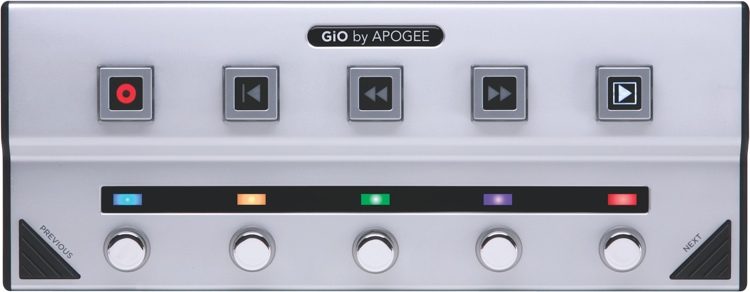
GiO frees you from key-command recording allowing you to concentrate on your performance and not the space bar. The five transport buttons on GiO let you record, play, stop and quickly navigate thru your track without taking your hands off the neck of your guitar.
'Next' preset please.
Previous and Next preset select buttons let you quickly audition and toggle between guitar amps and effects presets in Logic and GarageBand and the patch lists in MainStage.
Inputs and Outputs with GiO
Instrument input
GiOs 1/4 instrument input features Apogees world-class instrument preamp and converters. Hear and record your guitars true tone straight into Apples GarageBand, Logic and MainStage without compromise. GiO is optimized for all pickup configurations from the most basic single coil to sophisticated active electronics setups.
MIDI Expression pedal input
GiOs Expression control pedal input allows access to traditional effects like wah-wah, and volume. Also, control effects parameters like the length of a delay or the speed of a tremolo. (Expression Control Pedal not included)
USB
GiO is fully powered by the USB connection to your Mac eliminating the need for an external power source. Simply plug into an available USB port on any Mac and youre ready to go.
Output: Headphones, monitors or instrument amplifier
Hear your guitar and recording like never before. Connect your headphones, powered monitors or instrument amplifier to Apogee converters via GiOs 1/4 stereo output and listen to your guitar and mix with incredible clarity and dimension.
GiO Guitar Interface and Foot Pedal Controller for Mac
GiO Guitar Interface and Foot Pedal Controller for Mac
When ordered you will be contacted with an expected delivery date.
- Buy online, pickup at store
- In-store or phone support on all purchases
- Largest inventory of musical instruments in Canada
- Over 125 repair technicians across Canada to meet your service needs
Web Store
Web Store
Phone Number: 1-855-588-6519
For service in French: 581-741-4663
e-mail: websales@long-mcquade.com
Monday: 9:30am – 8:00pm
Tuesday: 9:30am – 8:00pm
Wednesday: 9:30am – 8:00pm
Thursday: 9:30am – 8:00pm
Friday: 9:30am – 8:00pm
Saturday: 9:30am - 5:00pm
Today's Best Tech Deals
Picked by Macworld's Editors
Top Deals On Great Products
Picked by Techconnect's Editors
Apogee Drivers For Windows
Apogee Electronics GiO
When Apple introduced stompbox effects and amps with GarageBand ’09, I was among the reviewers who complained that wonderful as having virtual stompboxes was, the inability to control them as you played was a significant lapse. Guitarists routinely switch effects as they play and having to take your hand off the instrument to click a virtual switch ruins the musical flow.
Apogee Gio Review
Apogee has come up with a solution with its $395 GiO USB effects pedal-board controller. This sturdily-built controller is around 18-inches long, 7-inches wide, and 2.5 inches tall. It sports five on/off switches for enabling and disabling effects; Previous and Next buttons for cycling through guitar presets; and individual Record, Go To Beginning, Rewind, Fast-forward, and Play/Pause buttons. On the back of the GiO you find a single quarter-inch instrument input, a quarter-inch headphone/speaker jack, and one more quarter-inch jack for an expression pedal.
The GiO, in addition to acting as a way to trigger effects, is also a USB audio interface. Configure your music application correctly and you can monitor not only the instrument plugged into the GiO, but also the sound coming from your Mac—including tracks playing back in your digital audio workstation (DAW).
While its buttons and an attached expression pedal send standard MIDI Control Change messages and can therefore be used with any DAW application, the GiO was specifically designed with Apple’s GarageBand ’09 (), Logic Studio (), Mainstage 2 (included with Logic Studio), and Logic Express 9 () in mind. What makes that relationship special is the visual feedback the GiO provides when using one of these applications.
In play
Apogee Duet Driver Mac
After installing the GiO driver on your Mac, plug in the USB cable, make your audio connections, and launch your music application. If the application doesn’t configure itself automatically to use the GiO for audio input and output, you can open an audio preference within the application and manually make the assignment.
Apogee One Driver
When you couple the GiO with GarageBand and create a guitar track, the lights above the effect on/off switches glow the same color as the on-screen stompbox. So, for example, if you’ve dialed up the Eighties Alternative amp/effects preset, the first four lights glow gray, purple, turquoise, and blue to reflect the colors of the Sustain, Flanger, Chorus, and Delay stompbox effects on screen. This feature is more than just eye candy. If you’re using the GiO on a dimly lit stage, the color coded lights give you a fair notion of which effect is assigned to a particular switch.
You can’t use GiO to directly call up a specific preset, however. For example, if you need to switch between GarageBand’s Bluesbreaker and Low Down Blues setups you must stomp on the Next or Previous buttons multiple times to step through GarageBand’s presets. If you don’t have the time to perform multiple stomps in the middle of a song you can create presets of your own in the order you’ll need them so that they’re just a stomp or two away.
The GiO works similarly in Logic Studio, Logic Express, and Mainstage 2. The Transport buttons control Play/Pause, Fast Forward, Rewind, Record, and Go to Beginning and the Next and Previous buttons step you through effects presets. As with GarageBand, the stompbox effects in these applications are color-coded and GiO’s lights reflect the color of each effect.
Unlike GarageBand, Logic Studio, Logic Express, and Mainstage 2 allow you to assign functions—volume or wah, for example—to an expression pedal plugged into the GiO. To set up that pedal you first need to launch the GiOConfig utility and choose one of two expression pedal profiles—Yamaha (FC7) or Roland (EV-5). Most popular expression profiles match one of these standards. Once you’ve configured the pedal you can assign it within the application.
Macworld’s buying advice
The GiO works as advertised, is easy to set up, and is sturdy enough to stand up to even the most rigorous gigs. Most importantly, it’s convenient. While you can certainly start and stop recordings with the Mac’s keyboard, call up the presets you want with a mouse, and add expression when mixing, being able to stomp on a few handy buttons helps keep your mind on the music instead of the engineering. For those using Logic and Mainstage 2 in live performance, having a pedalboard like this is almost a necessity.
Apogee Electronics GiO
Pros
- Sturdy construction.
- Lights mimic color of stompboxes.
- Nearly all the functionality you need in a foot controller.